Firmware, Overclocking and Undervolting: Where Mining Margins Live
Mining margin is set by joules per terahash, not by terahash. A 50 TH/s machine running at 20 J/TH draws 1 kW, or 24 kWh a day — about $1.44 at $0.06 per kWh — against roughly $1.90 of gross daily income at the read-date network hashrate and an $84,692 BTC price. That leaves about $0.38 a day of margin after power, which is exactly the kind of number a firmware or voltage profile moves by half.

Key takeaways
- At $0.06 per kWh, a profile change that cuts power 15% while giving up 5% of hashrate lifts a 50 TH/s machine from about $0.38 to roughly $0.57 of daily margin — a 50% improvement on the same hardware.
- Overclocking is not automatically worse, but it is electricity-price dependent: at $0.06 per kWh a 10% hashrate gain with 15% more power slightly loses to stock, and the crossover sits near $0.05 per kWh.
- Scale turns small numbers into real ones: the same 15%/5% trade applied across 200 machines is about $38 a day, or roughly $13,870 a year.
- None of this touches pool economics. The listed fee — 4% on the PPS-settled block reward, 2% on the PPLNS-distributed components — applies to income, not to power, and it does not change when you re-profile a machine.
Definitions first
Three terms get used interchangeably and should not be. Firmware is the software that runs the control board: it sets fan curves, power limits and the voltage-frequency relationship the machine follows. Overclocking raises the frequency target, which raises hashrate and power together. Undervolting lowers the voltage supplied at a given frequency, which usually costs some hashrate but reduces watts more than proportionally.[1]
The metric that decides whether any of it helps is J/TH — joules consumed per terahash per second. Hashrate is what you sell to a pool; J/TH is what you pay for the privilege. A profile that improves hashrate while worsening J/TH can reduce margin, and it does so silently, because the hashrate number on the mining dashboard goes up.
The trade-off nobody prices
Every profile change is a trade of hashrate against watts, and the exchange rate is set by your electricity price. At $0.06 per kWh, one watt running continuously for a day costs $0.00144; 1 TH/s of hashrate at today's difficulty earns about $0.038 a day gross. That ratio is the whole decision: a profile that saves 100 watts and costs 1 TH/s is roughly break-even, and anything better than that is a gain.
| Profile | Hashrate | Efficiency | Power cost / day | Income net of listed 4% fee | Margin / day |
|---|---|---|---|---|---|
| Stock (20 J/TH) | 50 TH/s | 20 J/TH | $1.44 | $1.82 | $0.38 |
| Undervolt (17 J/TH, 5% hashrate given up) | 47.5 TH/s | 17 J/TH | $1.16 | $1.73 | $0.57 |
| Overclock (+10% hashrate, +15% power) | 55 TH/s | 20.9 J/TH | $1.66 | $2.01 | $0.35 |
Read the third row carefully, because it is counter-intuitive. The overclock produces more coin — $2.01 against $1.82 — and still leaves less margin than stock, because the extra watts cost more than the extra terahashes earn at this electricity price. At a facility paying $0.04 per kWh the same profile becomes the best of the three. That is why generic advice about overclocking is useless without a power price attached.
Example with two setups
Setup one: a single 50 TH/s machine at $0.06 per kWh. Stock leaves about $0.38 a day, the undervolt profile about $0.57. Over a month the difference is roughly $5.70 on one machine — small, but the machine did not change, and the entire gain came from re-flashing and re-testing a voltage curve.
Setup two: a 10 PH/s farm of the same machines — 200 units. The same profile change is worth about $38 a day, roughly $13,870 a year, with no new hardware, no additional capacity and no change to the pool arrangement. For a fleet of that size this is the largest single-item improvement available outside renegotiating the power contract.
Now scale the picture further. At 500 TH/s the daily gross figure is about $19.00 and, after the listed 4% fee on the block-reward component, about $18.24; at 20 J/TH that fleet draws 10 kW, costs $14.40 a day in power and leaves $3.84 of margin. At 5 PH/s the gross figure is about $189.97, net about $182.37, power $144, and the margin about $38.37 a day. Notice how the margin fraction stays roughly constant as the fleet grows — a profile change moves that fraction, while adding machines only multiplies it.
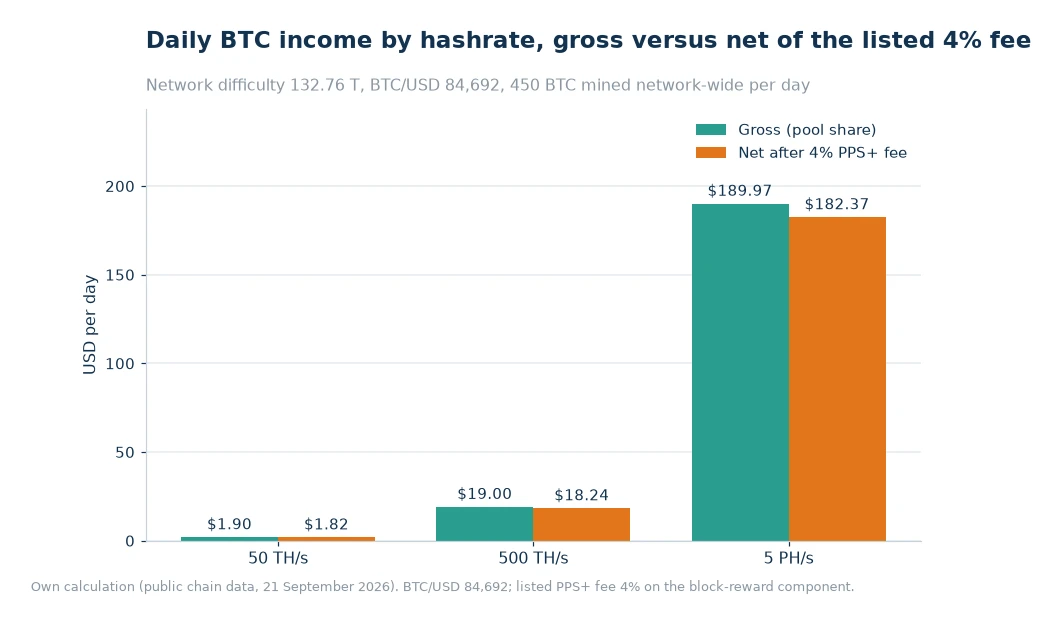
The chart also shows what a profile change cannot do. It cannot alter the gap between the teal and orange bars, which is the fee schedule; and it cannot change the network-wide income those bars are computed from, which is 450 BTC a day at the read-date difficulty. Firmware moves the cost side of your position on that chart; difficulty moves the chart itself.
Practical next steps
- Measure at the wall. Dashboard power figures are estimates. A plug meter on one representative machine is enough to validate a profile before rolling it out.
- Change one variable at a time. Voltage, frequency and fan curve interact; adjusting all three at once makes the result impossible to attribute.
- Reject profiles that lose hashrate without saving watts. The only acceptable trades are the ones in the table: fewer watts for a proportionally smaller hashrate loss.
- Watch the thermal derate, not the sticker. A profile that runs hotter will throttle in summer, and throttling silently converts your improvement back into stock hashrate at a worse J/TH.
- Check the vendor's stance on firmware. Warranty terms and support vary; keep the original image so any change is reversible.
- Recompute after every difficulty change. The estimate on the read date was −2.12%, which raises per-share income by roughly 2.2% and shifts where the overclock crossover sits relative to your power price.
Run the numbers before committing a fleet to a profile. A profit calculator that accepts coin price, difficulty, fee rate and effective hashrate gives the income side in seconds, and a mining pool dashboard confirms whether the hashrate you think you unlocked is actually being credited after the change.
Everything above sits inside a broader question: whether the machine should be running at all. That question belongs to a ViaBTC Bitcoin Mining style profitability check rather than to a firmware discussion, because a machine that cannot cover its own power at current price and difficulty will not be rescued by an efficiency profile.
Frequently asked questions
Do mining pools cost anything to join?
Joining is free; the pool earns from its fee on settled payouts, which appears as a percentage of the block-reward and transaction-fee components.
Can I mine more than one coin at the same time?
Yes. Merged mining lets a machine secure a parent chain and an auxiliary chain together, and multi-coin pools support switching between chains without moving hardware.
Does undervolting always increase mining profit?
No. It depends on the power price: an undervolt wins when the money saved on watts exceeds the value of the hashrate given up. At $0.06 per kWh a 15% power reduction for a 5% hashrate loss is a clear gain, while cheap power can make the same trade neutral.
How do I know whether a machine is still worth running?
Compare its power cost per day with its expected income at current difficulty and price, using a miner profitability ranking rather than the label hashrate. A machine that cannot cover its own electricity will not be fixed by a firmware profile.
The short version
Firmware work is margin work: convert every profile into watts per day and dollars of income per day, then keep only the trades that clear. At $0.06 per kWh an undervolt that gives up 5% of hashrate for 15% less power is clearly worth it, while a +10% overclock at +15% power is not. Multiply by fleet size before deciding, and re-run the arithmetic after each difficulty adjustment, because the crossover moves with it.
Data and sources: ViaBTC miner profitability and calculator tools[1] and the ViaBTC fee schedule[2]. Network hashrate, difficulty, subsidy and BTC price read from public chain data on 21 September 2026. Power and efficiency figures are illustrative models, not hardware guarantees.