Onboarding a Fragrance Manufacturer: From First Inquiry to First Order
Onboarding with a fragrance manufacturer is a process with a shape: inquiry, brief, sampling, commercial terms, and first order. Brands that treat it as a single 'send the brief and wait' step lose the most time and money, because each phase has its own deliverable and its own decision. Knowing what belongs to which phase is the difference between a smooth first order and a costly re-run.
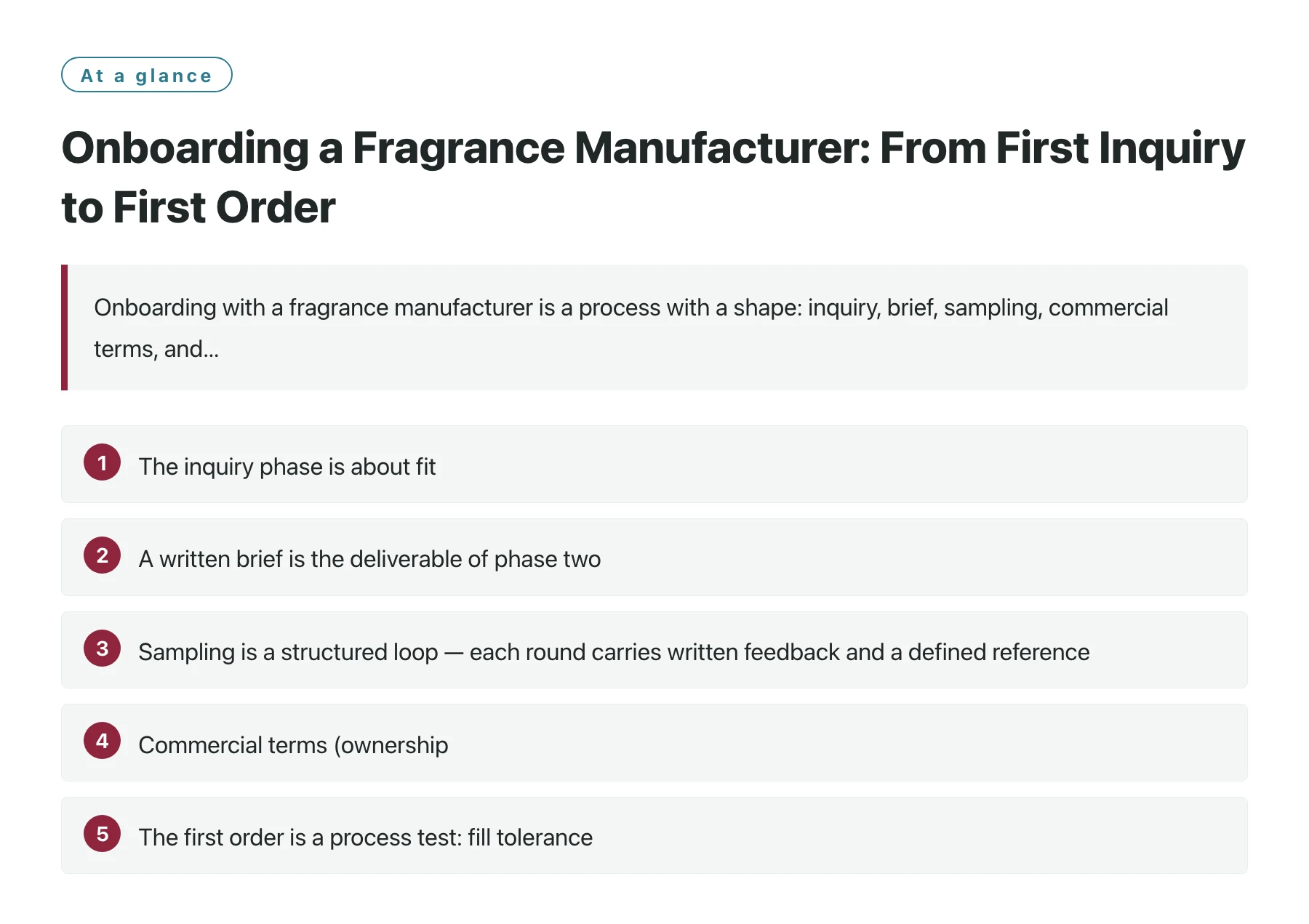
Key takeaways
- The inquiry phase is about fit, not price: the factory needs your market, category and volume expectations before a quote can mean anything.
- A written brief is the deliverable of phase two, and its quality decides how many sample rounds you will need.
- Sampling is a structured loop — each round carries written feedback and a defined reference, not just a new smell.
- Commercial terms (ownership, exclusivity, MOQ, payment) should be settled before the first bulk order, because they cannot be retrofitted after [1].
- The first order is a process test: fill tolerance, decoration match and document pack are the pass criteria to agree in advance.
Most fragrance projects that go wrong fail in onboarding — not because the factory was bad, but because the phases were mixed together: the brief was half-finished, the price was discussed before the scope, and ownership terms were never settled until they mattered.
This article maps the five phases of onboarding a new brand with a manufacturer, and names the deliverable and the decision that belong to each one.
The five phases of onboarding
- Inquiry and fitTell the factory your market, category, format and rough volumes. Fit is about whether they have done your kind of project, not about the price yet.
- BriefDeliver a written brief: scent direction, performance, format, price ceiling, compliance needs. This document decides how many rounds sampling will take.
- SamplingIterate in rounds, each with written feedback and a retained reference. Approve a physical sample with a date and a batch code, not a photograph.
- Commercial termsSettle formula and mould ownership, exclusivity, MOQ, lead times and payment before the first bulk order — in writing [1].
- First orderAgree the pass criteria in advance: fill weight within tolerance, decoration matching approved art, and the document pack your market needs.
Deliverables and decisions, phase by phase
| Phase | Main deliverable | Decision the brand makes |
|---|---|---|
| Inquiry | A capability summary that matches your category | Whether this factory is a candidate |
| Brief | A written product brief both sides can quote against | The scent family, format and price ceiling |
| Sampling | An approved physical sample with reference code | Which sample becomes the standard |
| Terms | A signed agreement covering ownership and scope | What you are willing to pay for exclusivity and files |
| First order | A batch meeting the agreed pass criteria | Whether to scale with this factory |
Read the last column as the honest workload: onboarding decisions are the brand's to make, and a factory's job is to force them to the surface before money moves — not to make them quietly for you.
How to make the phases productive
The biggest lever in onboarding is the brief. A brief that names the scent family, the performance target, the format and the budget range lets the factory use its first round intelligently; a brief that says 'make something nice' starts the clock on guesswork. Time spent on the brief is returned many times over in sample rounds.
The second lever is feedback discipline in sampling. Written feedback referencing the previous round — 'round two, more mineral, less sweet' — keeps the loop moving. Verbal commentary disappears; written references accumulate into the approval file.
The third lever is timing. Decide your launch date before you sign, then check the factory's stage-by-stage calendar against it — development, stability, tooling, documentation [1]. A factory that pushes back with a realistic calendar is managing your expectations; one that promises everything costs you the plan.
New brands also benefit from reading how established brands approach the process. The literature on how to build your own perfume brand spends most of its pages on exactly these phases, because the discipline is the same regardless of size. And when you evaluate the factory's own framing — whether it presents itself as offering one-stop fragrance manufacturing from development to filling — you are checking whether the onboarding you are about to run will have one accountable thread or several.
Finally, use the factory's public presence as an onboarding tool. A manufacturer that documents its services and processes publicly — the way https://www.xuelei.com describes its OEM/ODM, private label, development and filling scope — gives you a checklist to verify against before the first call. The public description is the claim; the onboarding conversations and the documents are where you confirm it.
The onboarding rule of thumb: never let a phase advance with an undecided deliverable. If you are sampling before the brief is written, or discussing price before the scope is defined, stop and go back one phase. The cost of redoing a phase is always smaller than the cost of the confusion it prevents.
Sources
- WIPO — World Intellectual Property Organization —— The UN agency for intellectual property; resources on industrial design and patent protection relevant to product and packaging design.
Frequently asked questions
How long does onboarding with a fragrance manufacturer take?
From first inquiry to a signed terms agreement, two to six weeks is common, with sampling rounds inside that window. The first bulk order then runs on its own lead time, driven by stability, tooling and documentation.
What should my first inquiry include?
Your market, category, format, rough volume and a one-paragraph scent direction. Enough for the factory to say whether it has done your kind of project — without yet needing the full brief.
How many suppliers should I take through onboarding?
Two or three is practical: enough to compare responses to the same brief, few enough to keep the sample rounds and negotiations manageable.
At which point is it fair to ask about ownership and exclusivity?
Before sampling is finished, ideally as part of the commercial terms phase. Ownership and exclusivity shape the value of the whole project, so they belong in the same conversation as price .
What is the most common onboarding mistake new brands make?
Skipping the written brief. The downstream cost — extra sample rounds, misunderstood price ceilings, unmet performance targets — is almost always larger than the hour it takes to write the brief properly.